TWO-DIMENSIONAL MATERIALS
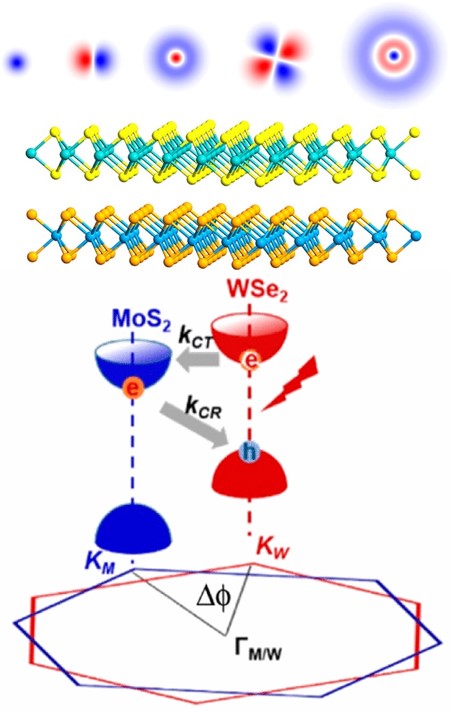
We use optical pump-probe spectroscopies, time- and angle-resolved photoemission spectroscopy, and terahertz time-dependent spectroscopy to study excitons and carriers in two-dimensional semiconductors, such as transition metal dichalchogenides (TMDCs), ferroelectrics, ferromagnets, and even combination of them. Of particular interest are electron-electron interaction in TMDC hetero/homobilayers, electron-phonon coupling in ferroelectrics, magnon-exciton coupling in antiferromagnets.
J. Am. Chem. Soc. 2024, 146, 14, 10052–10059
Phys. Rev. Lett. 2024, 132, 126501
Nano Lett. 2023, 23, 24, 11621–11629
Nano Lett. 2021, 21, 23, 9903–9908
Nat. Mater. 2021, 20, 1657–1662
SUPERATOM SOLIDS
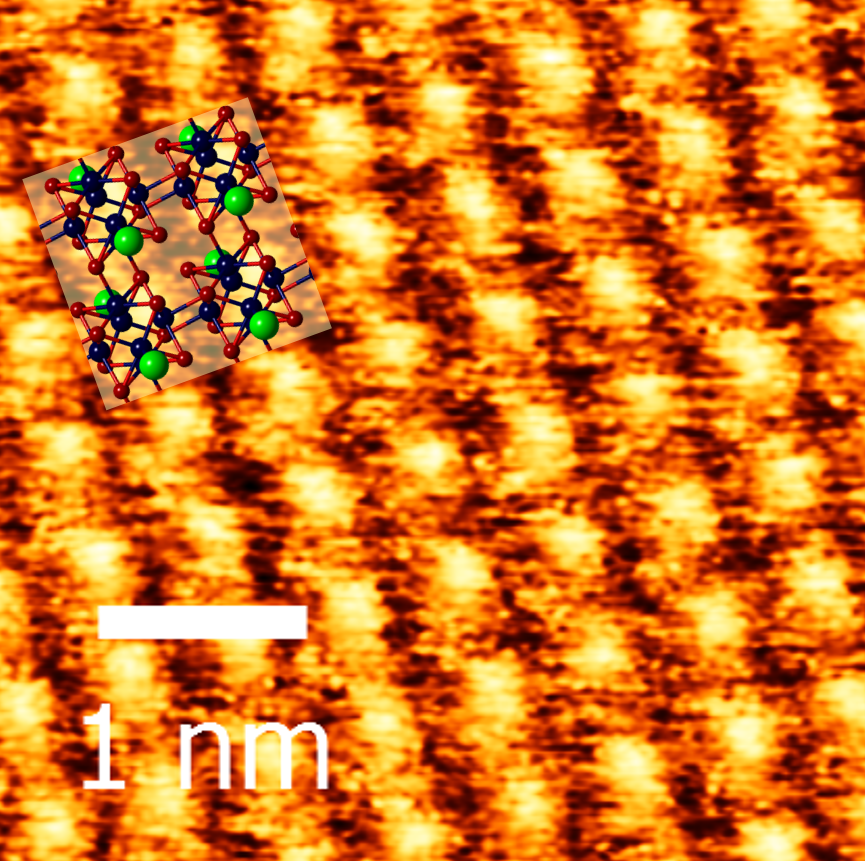
Superatom solids are a new class of materials assembled with nanoscale building blocks of superatomic motifs. This synthetic approach allows us to manipulate material structures and their optical, electronic, and magnetic properties. We can tune optical gaps broadly from mid-IR to the visible region, and control the structural dimensions between 0D, 1D, 2D, and 3D. We are studying emergent properties of the materials with optical spectroscopies and scanning-tunneling microscopy.
Adv. Funct. Mater. 2019, 29, 1902951
Nano Lett. 2018, 18, 1483-1488
 LIGHT-MATTER INTERACTIONS
We study the fundamental interaction of light with matter, such as lasing and polariton condensates in low-dimensional cavities. In particular, we aim to understand the fundamental scattering processes responsible for polariton condensation and coherent light emission.
Acct. Chem. Res. 2019, 52, 2950-2959
Nat. Mater. 2015, 14, 636-642.
 X.Y. Zhu Group